Focus Supplements Without Caffeine: What Is Studied, What Is Hype
Quick answer
Memodyne has no caffeine or other stimulant on its label. Phrases like supports focus are structure/function claims the FDA does not approve in advance. Expert groups do not back any brain supplement, and the FTC won a seven-year case over Prevagen’s memory claims. Sleep, activity and organization have better support.

Plenty of people want to concentrate better without reaching for one more coffee. That wish is the gap stimulant-free focus products aim at, and it is where Memodyne is sold: a capsule labeled for focus, clarity and energy, with no caffeine in it.
We sell it. So here is a plain account of what a label like that can promise, what the research on non-stimulant brain products shows, and how regulators have treated memory claims that went too far.
Does Memodyne contain caffeine or any stimulant?
No. The Supplement Facts panel lists niacin, calcium, two forms of arginine, two forms of citrulline and beta alanine, plus a vegetable capsule, vegetable stearate and silicon dioxide. There is no caffeine, guarana or other stimulant on it.
The brand also says the formula is made without artificial stimulants. The word ENERGY on the bottle is therefore not a caffeine promise. We found no source showing that these amounts make anyone feel more awake. Every line of the label is on our Memodyne Supplement Facts page.
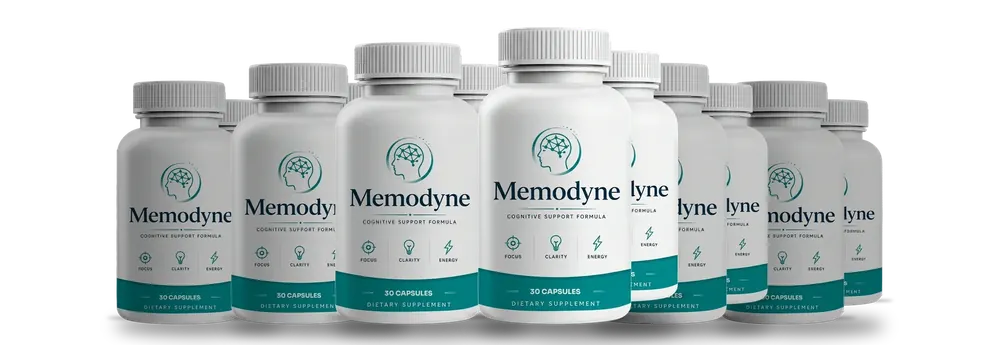
Want the lowest Memodyne price? It comes with the 6-bottle pack.
Best price: $49/bottle when you take 6 ($294). Free shipping on 3+ · 60-day money-back window · Checkout by BuyGoods.
What does “cognitive support” or “supports focus” mean on a supplement label?
It is a structure/function claim, a type of wording the law allows without FDA approval. The FDA says such claims describe how an ingredient affects normal body function, are not approved in advance, and must be truthful and not misleading (FDA, Structure/Function Claims).
The maker must tell the FDA about the claim within 30 days of selling the product, and the label must carry a disclaimer that the FDA has not evaluated it. The NIH adds that the FDA does not decide whether a supplement works before it goes on sale (NIH ODS, Dietary Supplements: What You Need to Know).
Memodyne prints that disclaimer next to an asterisk on COGNITIVE SUPPORT FORMULA. The words on the bottle are a claim the company stands behind, not a finding anyone has checked.
What does the evidence say about focus and brain supplements without caffeine?
Not much in their favor. Expert groups have looked at stimulant-free brain products as a class, and the table sums up what each source found.
| Ingredient or group | What the source found | Source |
|---|---|---|
| Any brain health supplement | Could not endorse any; evidence does not support any to prevent or slow decline | (Global Council on Brain Health (AARP), The Real Deal on Brain Health Supplements) |
| Ginkgo | No conclusive evidence it prevents or slows decline | (NCCIH, 7 Things To Know About Supplements and Alzheimer's) |
| Ginkgo, large NIH trial | No better than placebo at preventing or delaying Alzheimer’s | (Alzheimer's Association, Alternative Treatments) |
| B vitamins, short term | Did not improve thinking in older adults | (NCCIH, 7 Things To Know About Supplements and Alzheimer's) |
| Beta-alanine, 2.4 g a day | No overall difference; a company-funded subgroup gain | (Nutrients 2023, Ostfeld et al., beta-alanine and cognition in older adults) |
| L-arginine | Memory use rated insufficient evidence | (RxList, L-Arginine (supplement monograph)) |
Most of this research measured memory or decline, not day-to-day focus. We found no source that tested any of these for concentration at work or study, which is itself worth knowing before you pay for a focus claim.
What happened in the FTC’s Prevagen case, and why does it matter?
It is the clearest public example of a memory claim tested in court. Prevagen is made by Quincy Bioscience, a different company with no link to Memodyne. We include it because it shows what regulators expect of any brain claim.
- 2017
The lawsuit
The FTC and the New York Attorney General sued over claims that Prevagen improves memory within 90 days.
- 2017
The study problem
They said the company’s own placebo-controlled study found no statistically significant gain on any of nine tasks.
- 2019
Warning letters
The FTC and FDA wrote to other companies claiming their products treat or cure Alzheimer’s disease.
- 2022
The evidence rule
FTC guidance said health claims need competent and reliable science, usually randomized human trials.
- 2024
The ruling
After seven years, including a jury trial, a federal court ordered Quincy to stop misleading memory claims.
Sources: (FTC, Prevagen complaint (business blog)) (FTC consumer alert, Prevagen's fishy brainpower claims) (FTC consumer alert, FTC & FDA issue warning letters to supplement sellers (2019)) (FTC, Health Products Compliance Guidance) (FTC, Statement on win against Prevagen makers). None of these actions names Memodyne.
How can you tell when a focus or memory claim goes too far?
Check the wording against the label, and check the label against a study of the same dose. FTC guidance says an advertiser should compare its dose and formula with the one studied, and that testimonials are never enough to prove an effect (FTC, Health Products Compliance Guidance). Here is that test run on Memodyne’s own marketing.
- On the label
COGNITIVE SUPPORT FORMULA
Front of the bottleA structure/function phrase, printed with the FDA disclaimer.
- Marketing only
directly targets the real causes of memory loss
Sales pageNo study of the formula exists, and no source ties these ingredients to memory.
- Marketing only
recover your memories quickly
A post-checkout offer pageThe kind of quick-fix promise the FDA lists among health fraud tip-offs.
- Marketing only
feel 10 or even 20 years younger
The same offer pageNo evidence offered anywhere.
- Not shown
Scientific References
Sales page logo stripJournal and newspaper logos with no study attached, one of them an obesity journal.
The FDA’s six tip-offs to health fraud include one product that does it all, quick fixes, miracle cures and personal success stories (FDA, 6 Tip-offs to Rip-offs: Don't Fall for Health Fraud Scams). We would rather you hold us to that list than take our word for anything.
How can you improve focus without caffeine or a capsule?
Start with the habits health sources do back. The Mayo Clinic’s memory tips include physical activity, quality sleep, staying organized, mental activity and time with other people (Mayo Clinic, Memory loss: 7 tips to improve your memory). None of them comes in a bottle.

- Move before the hardest task of the day, even for a short walk.
- Write tomorrow’s top three tasks down tonight.
- Protect a regular bedtime on work nights.
- Tackle tough problems with a colleague instead of alone.
- Bring your medicine list to your next visit; some medicines affect memory.
If focus has slipped for weeks, look past supplements. The NIA lists depression or stress, medicine side effects and thyroid problems among causes of dementia-like symptoms that treatment may reverse (NIA (Alzheimers.gov), What Is Dementia?). Our memory and focus guide covers the warning signs.
Where does Memodyne sit among stimulant-free focus products?
Among the low-dose ones. Memodyne lists every amount, which is more than many brands do, and it has no caffeine. But its amino acids sit far below the gram doses used in research, and no study links them to focus or memory.
If you want to try it, treat it as an experiment with a refund window, not a fix. Keep your sleep, movement and medicine review in place. Anyone on nitrates, ED drugs or blood pressure medicine should ask a doctor first, for reasons set out on our Memodyne side effects page.
Questions about focus without caffeine
Does Memodyne have caffeine?
No. The label lists no caffeine or other stimulant, and the brand says the formula has no artificial stimulants.
What is the best brain supplement without caffeine?
No source we read backs one. The Global Council on Brain Health does not recommend any supplement for brain health.
Can a supplement improve focus without caffeine?
We found no study showing it for any stimulant-free product we looked at. Sleep, activity and organization have better backing.
What does “supports focus” mean on a supplement bottle?
It is a structure/function claim. The FDA does not approve it in advance; the maker must be able to show it is truthful.
Was Memodyne part of the Prevagen lawsuit?
No. That FTC case concerned Prevagen and Quincy Bioscience. We cite it only as an example of how memory claims are judged.
Did the FTC win the Prevagen case?
Yes. In December 2024, after seven years and a jury trial, a federal court ordered the makers to stop misleading memory claims.
Will Memodyne keep me awake at night?
It contains no stimulant, and none of our sources lists sleeplessness among the side effects of its ingredients.
How can I increase alertness without caffeine?
Start with sleep, physical activity and a written plan for the day. If tiredness or poor focus lasts for weeks, see a doctor.
Page check
Written by
Compares each label amount with the doses used in published research, using NIH, FDA and Alzheimer's Association pages.
Reviewed by
Dr. Harald Hampel, MD, PhD, MD, Physician
Medical reviewer. Review date: October 13, 2026.
- Last compared with the label: October 13, 2026
- Facts come from the Supplement Facts panel and the brand pages; health lines come from the sources linked above
- Corrections go to [email protected]; our checking rules are on the standards page