
Licensed U.S. retail desk60-day money-back windowUS shipping is free on 3 or 6 bottlesBest price: $49/bottle when you take 6 ($294)

Memodyne Benefits: What Focus, Clarity and Energy Mean Here

Quick answer

The Memodyne bottle names three benefits: focus, clarity and energy.

The sales page adds memory and brain blood flow. The capsule has no caffeine, so do not expect a quick lift.

See how to track your own results.

Written by the Memodyne Editorial DeskUpdated

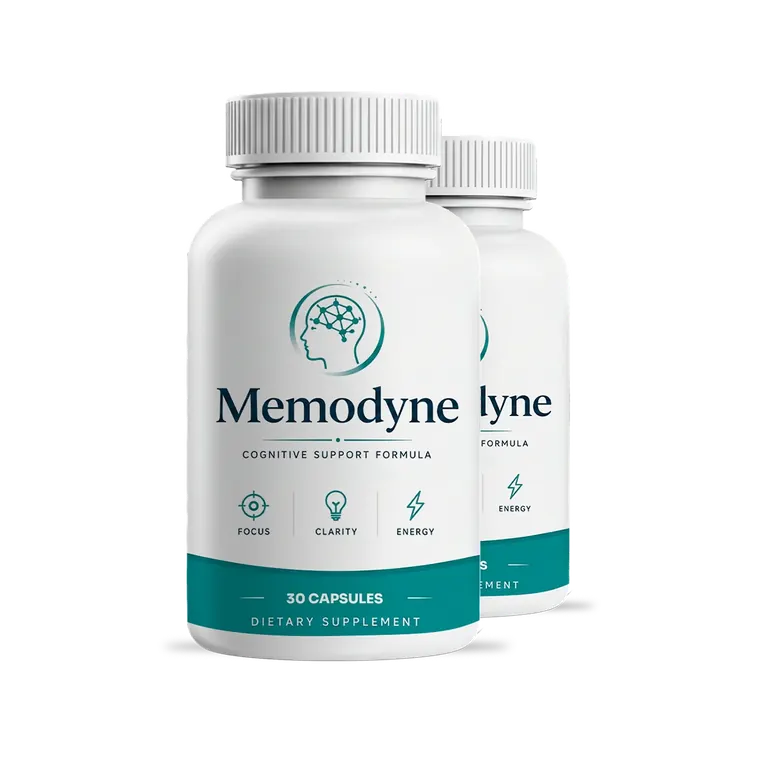
Two Memodyne bottles with Focus, Clarity and Energy icons on the teal label

What benefits does Memodyne promise, and where is each promise printed?

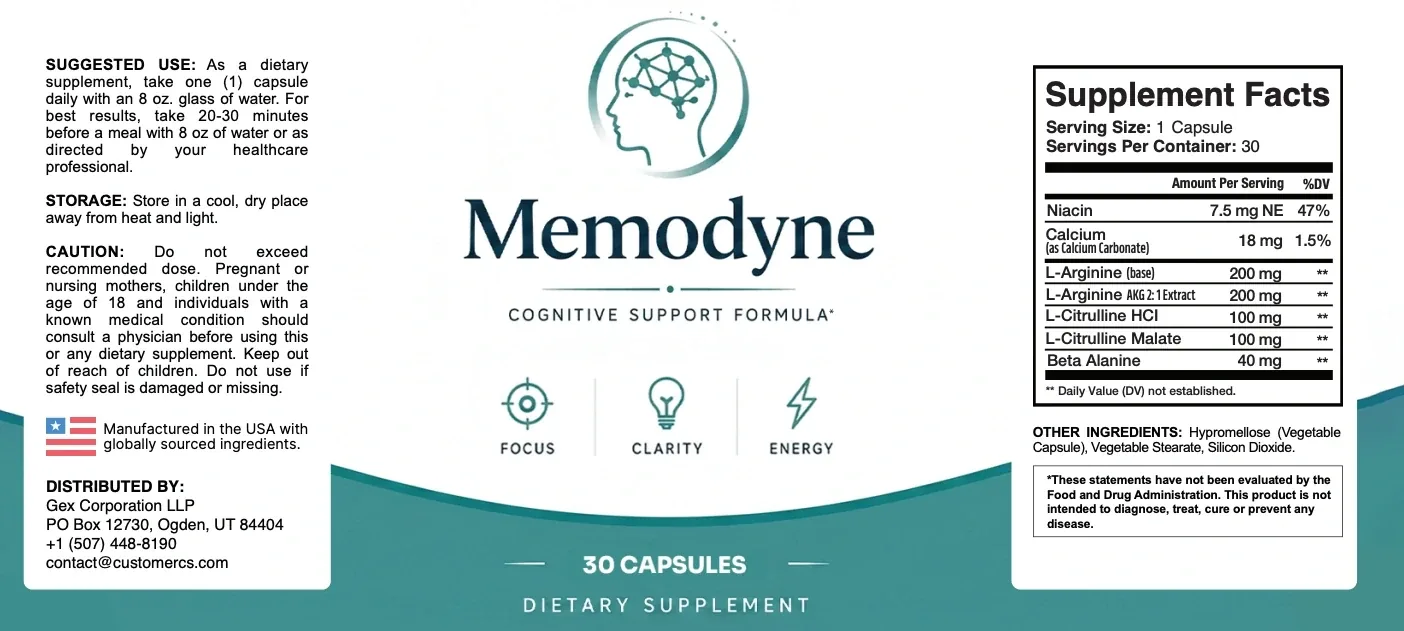
The bottle promises little; the website promises a lot. The Memodyne label carries three words, focus, clarity and energy, under the line "Cognitive Support Formula". The sales page goes much further, with memory, brain blood flow and protected neurons.

Brand illustration of a glowing brain inside the outline of a human head
Brand art from the Memodyne image set. It is a drawing, not a brain scan, and shows no measured effect.

That gap matters. Words on a supplement label must sit beside the FDA disclaimer and describe normal body function, not disease (FDA, Structure/Function Claims). Web copy is looser, so it is where the bigger promises live.

3benefit words on the bottle
5benefit lines on the sales page
0studies of the formula we could find

Focus, clarity, energy: what the three front-label words can fairly mean

Each card shows the word as printed. Turn it over to see what was studied, what was found, and how much of the ingredient one Memodyne capsule holds.

The Memodyne label, where Focus sits under the product name

Front-label word

FOCUS

Shown with a target icon

Sounds like better attention. The bottle gives no detail, no test and no amount of change.

FOCUS: the research

Studied at
Arginine and citrulline were studied at grams a day for blood pressure and exercise, not attention.
What studies found
No source we opened tested any label ingredient for focus in healthy adults.
Watch for
A sudden drop in concentration can come from sleep, stress or medicines. Worth raising with a doctor.
In Memodyne
A word on the label, without a study behind it
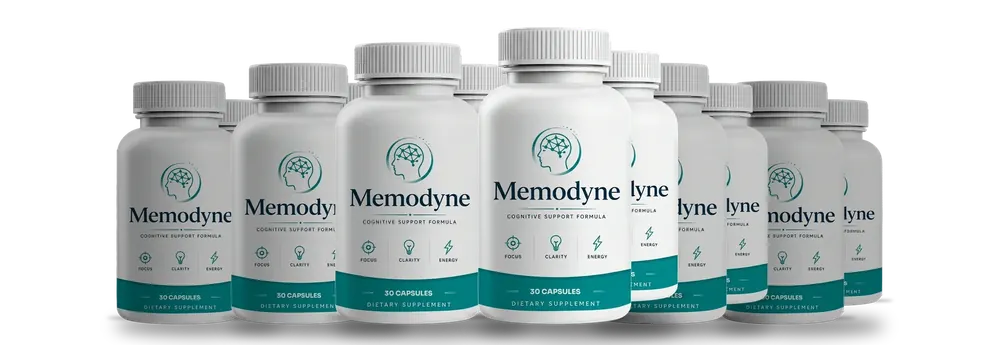
The Memodyne label, where Clarity sits beside Focus and Energy

Front-label word

CLARITY

Shown with a light bulb icon

Suggests a clearer head. On the bottle it is one word with a light bulb drawing.

CLARITY: the research

Studied at
Beta alanine was tested on thinking in older adults at 2.4 g a day. The label has 40 mg.
What studies found
That trial found no overall difference; only a subgroup improved (Nutrients 2023, Ostfeld et al., beta-alanine and cognition in older adults).
Watch for
Ongoing confusion is not a supplement question. See a doctor.
In Memodyne
40 mg of beta alanine, 1/60 of the trial dose
The Memodyne label, where Energy sits beside a lightning bolt icon

Front-label word

ENERGY

Shown with a lightning icon

Reads like a pick-me-up. There is no caffeine or other stimulant on the label.

ENERGY: the research

Studied at
Citrulline malate was tried at 8 g before workouts; arginine at 2 to 20 g a day.
What studies found
Little to no effect on exercise performance for arginine, weak support for citrulline (NIH ODS, Dietary Supplements for Exercise and Athletic Performance (health professional)).
Watch for
Lasting tiredness has many medical causes, from thyroid to sleep problems.
In Memodyne
Under 200 mg of citrulline in two forms

So the words describe what the brand hopes you feel, not a measured result. The step-by-step version of the science is on the how it works page.

Memodyne bottles

Want the lowest Memodyne price? It comes with the 6-bottle pack.

Best price: $49/bottle when you take 6 ($294). Free shipping on 3+ · 60-day money-back window · Checkout by BuyGoods.

Check today’s price

Does Memodyne work? The sales-page claims checked one by one

Not in any way a study has shown. Below are the brand's benefit lines, where each appears, and what we could and could not confirm.

  • Enhance memory function and support overall cognitive healthSales page, benefit list
    Marketing only

    No study of these ingredients or this formula measured memory.

  • Protect the brain from oxidative stress and improve mental claritySales page, benefit list
    Marketing only

    The NIH says antioxidant supplements have not been shown to prevent disease (NCCIH, Antioxidant Supplements: What You Need To Know).

  • Boost neural communicationSales page, benefit list
    Marketing only

    No opened source links any label ingredient to nerve signalling.

  • Optimize neurotransmitter productionSales page and seller pack
    Marketing only

    No source connects arginine, citrulline, beta alanine or niacin at these amounts to brain chemicals.

  • Directly targets the real causes of memory lossSales page, ingredient section
    Marketing only

    Memory loss has many causes, some treatable by a doctor. No capsule targets them.

  • Focus, clarity, energyBottle front
    On the label

    Printed on the label, with no study or test shown.

Health regulators have taken action against memory supplement claims before. The FTC sued the makers of a different product, Prevagen, over memory claims and won in 2024 (FTC, Statement on win against Prevagen makers). That case does not involve Memodyne; it shows why such claims need evidence.

Can a caffeine-free capsule give you energy?

Not the way coffee does. Memodyne has no caffeine and nothing that acts like it, so expect no buzz, no lift within the hour and no crash later. Some buyers welcome that; others expect a kick that never comes.

In the brand's copy the energy idea rests on niacin and citrulline malate. The niacin is 7.5 mg NE, about half an adult's daily need (NIH ODS, Niacin (health professional)), a nutrient-level amount rather than a boost. The citrulline malate is 100 mg, against 8 g in workout studies.

If stimulant-free focus is what you are after, our post on focus supplements without caffeine compares the options.

What can you realistically expect from Memodyne?

Most likely, no change you can pin on the capsule. That is the honest reading when doses are a small share of the studied amounts and no trial exists.

What to expect from Memodyne, set against the sources
HopeRealistic?Why
A clear lift on day oneNoThere is no stimulant, and the amino acids were never shown to act fast on attention
Sharper memory within weeksNo evidenceNo study of any label ingredient measured memory in healthy adults
Lower blood pressureUnlikelyEffects were seen at 3 to 24 g a day; one capsule holds well under 1 g of amino acids
Tingling or flushingUnlikelyThose start near 800 mg of beta alanine and 30 mg of niacin
A steady daily habitPossibleA once-a-day capsule can anchor a routine that includes the habits that do help
No noticeable changeMost likelyLow doses, no product study, and real focus swings from sleep and stress

Tingling and flushing thresholds: (ISSN position stand: Beta-Alanine (2015)) (NIH ODS, Niacin (health professional)). A guide to tracking how you feel is on the results timeline page.

What does help focus and memory, according to health sources?

Daily habits, not capsules. Mayo Clinic's memory tips list physical activity, mental activity, time with other people, staying organized, good sleep, a diet of fruits, vegetables and whole grains, and managing health conditions (Mayo Clinic, Memory loss: 7 tips to improve your memory).

  • Move most days: activity raises blood flow to the whole body, the brain included
  • Protect your sleep, one of the seven tips on that list
  • Keep a written list or calendar so memory does not carry every task
  • Ask your doctor to review your medicines, since some affect thinking

An expert panel convened by AARP put it bluntly: save your money and adopt healthy habits (Global Council on Brain Health (AARP), The Real Deal on Brain Health Supplements). More practical ideas are in our memory and focus guide.

When is a memory change a reason to see a doctor instead?

When it disrupts daily life, gets worse, or other people notice it. Memory loss that disrupts daily life, trouble planning and confusion about time or place are early warning signs that call for an appointment (Alzheimer's Association, 10 Early Signs).

Treatable causes first: Medicine side effects, low vitamin B12, thyroid, kidney or liver problems can all cause memory trouble, and they can be treated (NIA, Forgetfulness: Knowing When to Ask for Help). A supplement should never delay that visit.

Memodyne benefits, in short answers

What are the real benefits of Memodyne?

None has been shown in a study. The label promises focus, clarity and energy without any test behind those words, and the doses are far below those used in research.

Is there proof that Memodyne sharpens memory?

No evidence says so. No study of the formula exists, and no source we opened links its ingredients to better memory at any amount.

Will Memodyne help me focus at work or while studying?

There is no study showing it will. Sleep, breaks, exercise and fewer distractions have far more to offer.

Is the energy on the Memodyne label a caffeine kick?

No. It contains no caffeine or other stimulant, so there is no quick lift.

Can Memodyne help with brain fog?

No study shows that. Ongoing brain fog can come from sleep, medicines, thyroid problems or low B12, so it is worth a doctor's visit.

Is Memodyne clinically proven?

No. We found no clinical trial of the product, and a page calling it "clinically proven" belongs to a lookalike seller, not the brand.

Can Memodyne prevent dementia or Alzheimer's?

No. No supplement has been proven to prevent, treat or cure Alzheimer's, and the label itself says the product is not meant to prevent any disease.

Why does the Memodyne website promise more than the bottle?

Labels must stick to body-function wording with the FDA disclaimer. Sales pages are looser, so the larger claims about memory and neurons appear only there.

Page check

Written by

Memodyne Editorial Desk

Compares each label amount with the doses used in published research, using NIH, FDA and Alzheimer's Association pages.

Reviewed by

Dr. Harald Hampel, MD, PhD, MD, Physician

Medical reviewer. Review date: October 13, 2026.

  • Last compared with the label: October 13, 2026
  • Facts come from the Supplement Facts panel and the brand pages; health lines come from the sources linked above
  • Corrections go to [email protected]; our checking rules are on the standards page