What Is in Memodyne? The Seven Label Lines and What Each One Is
Quick answer
One Memodyne capsule lists niacin 7.5 mg NE, calcium 18 mg, L-arginine 200 mg, L-arginine AKG 200 mg, L-citrulline HCl 100 mg, L-citrulline malate 100 mg and beta alanine 40 mg. The shell is hypromellose. There is no blend and no caffeine. Arginine and citrulline are salts, so their true amounts are lower.
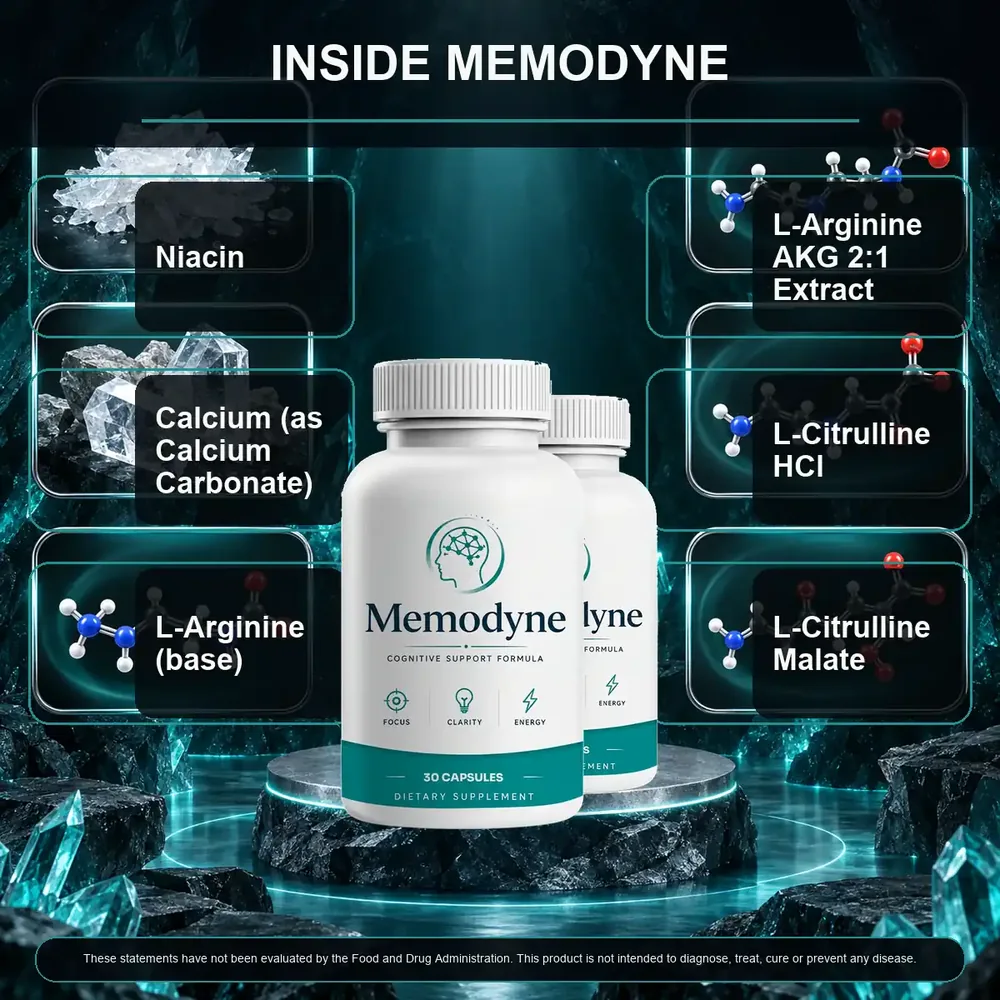
A supplement label is a short document that most buyers never read. Memodyne's is easy to read, which is a point in its favor. Seven lines, seven amounts, and no secret blend. That is more than many brands print.
Here we go through the list by type: the amino acids first, since they make up most of the weight, then the vitamin and the mineral, then the capsule shell. After that we cover what is missing, and how to use the list to spot a look-alike bottle.
Key facts
- Serving size is 1 capsule, and a bottle holds 30 servings.
- Seven rows are printed with amounts: niacin, calcium, L-arginine, L-arginine AKG 2:1, L-citrulline HCl, L-citrulline malate and beta alanine.
- The printed rows add up to 665.5 mg per capsule: 640 mg of amino acids, 7.5 mg of niacin and 18 mg of calcium.
- Other ingredients: hypromellose (vegetable capsule), vegetable stearate and silicon dioxide.
- No proprietary blend, no caffeine, no stimulant and no allergen line is printed.
- The brand's sales page names six ingredients and leaves out calcium. When lists disagree, the bottle label wins.
- The form of niacin is not stated, and the exact arginine share of the AKG row is not published.
What does the Memodyne Supplement Facts panel list?
Here is the panel as printed, in the label's order. Only two rows show a percent Daily Value. The five amino acid rows show two stars instead, which stand for a Daily Value that is not established.
| Row on the label | Amount per capsule | Percent Daily Value |
|---|---|---|
| Niacin | 7.5 mg NE | 47% |
| Calcium (as calcium carbonate) | 18 mg | 1.5% |
| L-arginine (base) | 200 mg | ** |
| L-arginine AKG 2:1 extract | 200 mg | ** |
| L-citrulline HCl | 100 mg | ** |
| L-citrulline malate | 100 mg | ** |
| Beta alanine | 40 mg | ** |
The footnote reads that the Daily Value is not established. That is not a warning and not a sign that something is hidden. It means no official daily target exists for arginine, citrulline or beta alanine.
What are the two arginine lines, and how much arginine is really there?
The first line is plain L-arginine, 200 mg. The second is L-arginine AKG 2:1, also called AAKG: arginine bound to alpha-ketoglutarate. It is one compound, not arginine plus a separate AKG pill.
Because the second row includes the AKG partner, its 200 mg holds less than 200 mg of arginine. Together the two rows weigh 400 mg, so the real arginine is under 400 mg. The label does not print the split, and no source we opened gives it, so we do not guess a number.
For scale, arginine was studied at 4 to 24 g a day in blood pressure work (RxList, L-Arginine (supplement monograph)). That is the main reason the label looks modest next to the research. Arginine can also lower blood pressure and may add to certain medicines, which is covered on our safety pages.
What are the two citrulline lines?
Citrulline HCl and citrulline malate are two salt forms of the same amino acid, 100 mg each. HCl is citrulline paired with hydrochloride. Malate is citrulline bound to malic acid.
Both partners add weight, so the capsule holds under 200 mg of citrulline itself. The body turns most citrulline into arginine in the kidneys, about 80% of it according to the NIH (NIH ODS, Dietary Supplements for Exercise and Athletic Performance (health professional)), so the two amino acids feed one pool.
Blood pressure trials of citrulline used 3 to 9 g a day (Avicenna J Phytomed 2019, Barkhidarian et al., L-citrulline and blood pressure meta-analysis). Exercise tests used 8 g of the malate form before testing. One capsule is a small share of either.
If the list suits you and your doctor has no objection, the order page shows the packs and the 60-day guarantee.
This site earns a commission if you order through this button. The price you pay does not change.
Why is there beta alanine in Memodyne?
The label does not say. The brand's copy says beta alanine raises carnosine in the brain and protects neurons. The sports research that raised carnosine did it in muscle, at 4 to 6 g a day (ISSN position stand: Beta-Alanine (2015)). The capsule has 40 mg, about 1% of the low end.
At 40 mg, the pins-and-needles feeling that beta alanine can cause is unlikely. It is common from about 800 mg taken at once. Odd as it may seem, the brand's own ingredient graphic leaves beta alanine out, though the bottle lists it.
The one trial that tested beta alanine on thinking, in older adults, used 2.4 g a day for 10 weeks and found no overall difference from placebo (Nutrients 2023, Ostfeld et al., beta-alanine and cognition in older adults).
What do the niacin and calcium lines mean?
Niacin is vitamin B3. It is counted in niacin equivalents, shown as NE, because the body can also make it from an amino acid in food. Adult needs are 16 mg NE for men and 14 mg NE for women, and the Daily Value is 16 mg (NIH ODS, Niacin (health professional)). So 7.5 mg NE is a little under half a day's need, which is where the printed 47% comes from.
The label does not name the form of niacin. That matters because flushing comes from nicotinic acid at 30 to 50 mg or more. At 7.5 mg flushing is unlikely either way.
Calcium is 18 mg as calcium carbonate, printed as 1.5% of a Daily Value of 1,300 mg (NIH ODS, Calcium (consumer)). It is a nutrient-level amount, not a calcium supplement. If you take levothyroxine, ask a pharmacist about spacing, since calcium carbonate can reduce its absorption.
What is the capsule itself made of?
Hypromellose, a vegetable capsule, plus vegetable stearate and silicon dioxide as the other ingredients. No allergen line is printed.
A vegetable shell with no grain or milk ingredient on the list fits a vegetarian, gluten free and dairy free product. We say very likely, not certified. The seals on the brand's images do not name a certifier, so they cannot be looked up.
A word on 100% natural, which also appears as a seal. Arginine AKG and the two citrulline salts are made compounds, and silicon dioxide is on the list. Natural also does not mean safe, as the NCCIH notes (NCCIH, Using Dietary Supplements Wisely).
What is not in Memodyne?
No caffeine, guarana or other stimulant. No proprietary blend. No herbs, no probiotics, no fiber. The word energy on the front is therefore not a caffeine promise.
Also missing from the public record: the exact arginine share of the AKG row, the form of niacin, the manufacturer's name and a lab report for any lot. Those are the four blanks that matter for anyone who wants to check the label against a measurement.
The distributor block names Gex Corporation LLP of Ogden, Utah. It does not name a maker.
How can you use the list to spot a bottle that is not the real product?
Hold the bottle beside the panel above. The product sold on the brand's site has a white bottle with a teal label, the name Memodyne, the words Cognitive Support Formula, and 30 capsules.
- A missing line, an extra herb or a changed amount means you have something else.
- A different name, other colors or a different claim line is not the product on the brand's site.
- A damaged or missing safety seal is a reason not to use the bottle.
The order desk can match a bottle to an order by phone at +1 (302) 200-3480. Have the order ID ready.
Frequently asked questions
What are the ingredients in Memodyne?
Per capsule: niacin 7.5 mg NE, calcium 18 mg, L-arginine 200 mg, L-arginine AKG 2:1 200 mg, L-citrulline HCl 100 mg, L-citrulline malate 100 mg and beta alanine 40 mg.
How much arginine is in one Memodyne capsule?
Under 400 mg. The label lists 200 mg of plain L-arginine and 200 mg of arginine AKG, and part of the AKG row is not arginine.
Does Memodyne use a proprietary blend?
No. Each of the seven lines prints its own amount.
Does Memodyne contain caffeine?
No caffeine or other stimulant appears on the label.
Why does the brand's website show only six ingredients?
Its ingredient section leaves out the 18 mg of calcium. The bottle lists all seven, and the bottle is the source we follow.
What is the Memodyne capsule made of?
Hypromellose, a vegetable capsule, with vegetable stearate and silicon dioxide as other ingredients.
Our view
Our view: the label is the best thing about Memodyne's paperwork. Every amount is printed, nothing hides in a blend, and the capsule has no stimulant. That makes it easy to compare with research.
The comparison is where the claims lose force. Each active amount is a small share of the doses studied for any outcome, and none of the studies measured memory. Read the label as an honest list of contents and judge the promises on the evidence, not on the packaging.
Last updated October 29, 2026. Medically reviewed by Dr. Harald Hampel, MD, PhD, MD, Physician, October 16, 2026.
Read the label twice, then the refund rules once. The order page puts the price and the guarantee in front of you.
This site earns a commission if you order through this button. The price you pay does not change.
Page check
Written by
Compares each label amount with the doses used in published research, using NIH, FDA and Alzheimer's Association pages.
Medically reviewed by
Dr. Harald Hampel, MD, PhD, MD, Physician
Medical reviewer. Review date: October 16, 2026.
- Last compared with the label: October 16, 2026
- Facts come from the Supplement Facts panel and the brand pages; health lines come from the sources linked above
- Corrections go to [email protected]; our checking rules are on the standards page